
GOOGLE RANKER PRO / INSIGHTS
Ecommerce SEO Checklist for Stockport Retailers
Use this ecommerce SEO checklist for Stockport retailers to fix product data, collection pages and mobile speed.
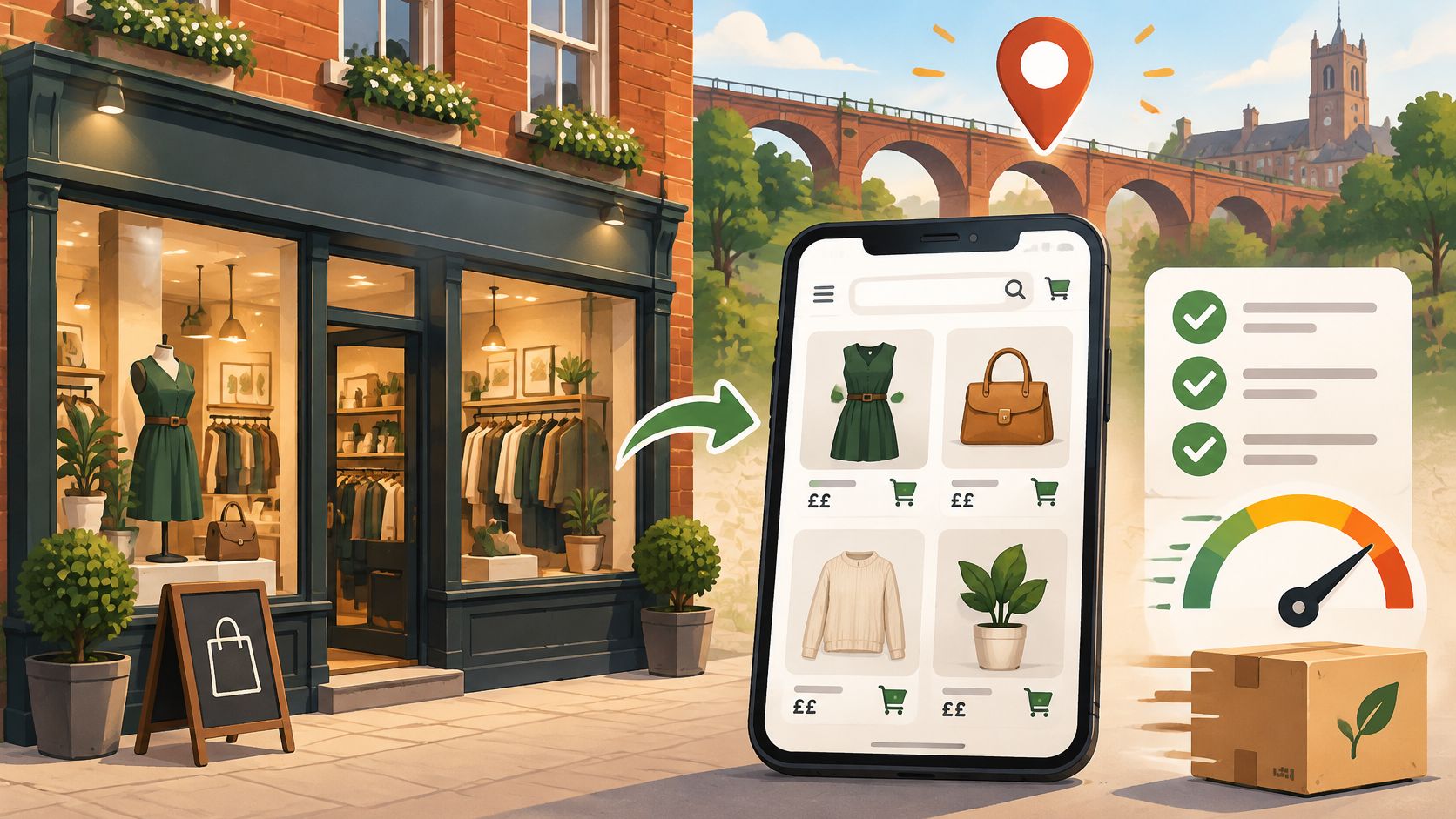
Internet sales accounted for 27.5% of total UK retail sales in 2025, according to the Office for National Statistics. For a Stockport shop, ecommerce SEO therefore deserves attention beyond adding a town name to product pages. The practical priority is making products easy to find, stock easy to trust, and collection or delivery easy to understand.
Meta description: A practical ecommerce SEO checklist for Stockport retailers covering product data, local stock, collection, mobile speed and sales measurement.
Why Stockport Shops Need Ecommerce SEO Now
A customer finds a lamp through search, likes the price, then looks for local collection. If the product page doesn't explain availability or collection arrangements, that customer still lacks the information needed to buy. A shop can have a searchable catalogue without offering a convincing buying journey.
Ecommerce SEO means making product, category and collection pages clear to search engines and to people comparing price, stock and how they can get an item. For a retailer offering online ordering alongside a physical Stockport shop, those tasks belong together.
Online shopping remains a core retail channel
The ONS retail sales series records internet sales at 16.3% of UK retail sales in 2017, compared with 27.1% in 2024. These are UK-wide figures, not a Stockport market study, but they establish why online product discovery deserves commercial attention.
Demand also changes within the year. According to the ONS September retail sales bulletin, Great Britain's online spending values in the third quarter of 2025 were 3.5% higher than in the second quarter and 5.0% higher than a year earlier, while September's online share reached 28.0%, against 27.8% in August.

Build around the buying decision
A sensible starting point is to check whether a shopper can establish:
- What is available: The correct product, variant, price and stock position.
- How to receive it: Delivery coverage, charges and collection arrangements.
- Whether buying is straightforward: A usable mobile page and a working route into checkout.
Search advertising and unpaid visibility need separate budgets and measurement. Google Ranker Pro's guide to SEO or Google Ads explains that planning decision.
The scored checklist below turns the buying journey into concrete checks, rather than treating rankings as the final result.
The Ecommerce SEO Checklist You Can Score
Give every row one of three marks: Pass, Fix or Not applicable. A pass only counts when you can point to proof, meaning a live page, a completed test or the relevant account setting. A plugin being installed is not proof.
Ecommerce SEO checklist for a Stockport retailer
| Check | Pass standard | When to act |
|---|---|---|
| Product and category URLs | One indexable canonical URL per product or deliberate variant strategy; useful categories remain indexable | Fix first |
| Titles and headings | Name and intent match the visible product | Fix first |
| Internal links | Categories, related products and collection details are linked | This month |
| Product and Offer markup | JSON-LD matches visible GBP price, stock, shipping and returns | Fix first |
| Merchant Center feed | Price, stock, brand and images match the page | Fix first |
| Google Business Profile | Hours, categories and collection details are accurate | This month |
| Collection and delivery pages | Only real service areas, with charges and times | This month |
| Mobile page experience | LCP no more than 2.5s, INP no more than 200ms, CLS no more than 0.1 at the 75th percentile | Fix first |
| Measurement | Organic revenue, free listings and purchases split from rankings | This month |
| Seasonal landing pages | Stock, delivery and promotional pages reviewed before peak months | Before November |
Two terms decide several rows. An indexable page is one eligible to appear in search. A canonical URL marks the preferred version of a page when similar addresses exist, and filters, tracking parameters or location names can all generate competing copies of the same product. The practical test is whether search engines and shoppers arrive at the intended page.
Read the remaining rows the way a customer experiences the shop. Compare the search-facing title and page heading with the item displayed: a product title should separate the item and its important attributes, while a category title should describe the range. Stockport belongs in either only when location changes what is on offer. Then start from the navigation and browse. A product reachable only through the site's search box fails, and so does collection information buried in an unrelated footer page.
Order repairs by what blocks a sale
Price, stock and the route into checkout come before extra location copy. An item advertised as ready to collect but unavailable loses the sale whichever page ranks, and no amount of new content repairs that.
Before any work starts, record three things against each failed check. Give it an owner, meaning the person responsible for the catalogue, website, feed or shop information. Note the visible fault, meaning the exact URL and what disagrees on it. Define the retest, meaning the action that will demonstrate the repair worked. Treat a row marked Fix like a job card in the stockroom: it only becomes useful when someone knows what must change and how the change will be checked.
Shops on the relevant platform can use Yassine Malti's Shopify SEO checklist for 2026 as a platform-specific companion to this broader review. Apply its checks to the actual buying journey, or the list gets ticked off without anything being tested.
Local Stock and Collection Without Doorway Pages
Adding Stockport to every product title isn't local inventory SEO. A nearby shopper usually needs a more useful answer: whether the item is available, when collection is possible and whether the shop delivers to the relevant address.
Local discovery also extends beyond ordinary product results. DLR Media's account of UK local business discovery reports that Google Maps reached 78% of UK online adults in 2025, up from 73% in 2024.
Make a smaller range of locally available products exceptionally clear rather than publishing hundreds of thin town pages.
Make the local offer specific
The Stockport economic overview reports 304,879 residents, with 60.9% aged 16–64. That establishes a sizeable local population, not proof that every resident is a prospective customer.
Useful audience decisions still require search queries, website behaviour and sales records. A specialist homewares shop and a food retailer may serve very different customers despite sharing the same postcode area.

The local checks should cover:
- Business details: Keep the Google Business Profile's shop address, opening hours and categories accurate. A delivery area isn't a branch.
- Stock status: Publish live availability where possible, or regularly updated information with a clear confirmation process.
- Collection arrangements: Explain readiness notifications, collection times and what customers must bring.
- Delivery coverage: State eligible areas, charges and restrictions plainly.
- Useful local pages: Publish a Stockport collection page only where the service exists. Mention Cheadle, Bramhall or Marple where genuine differences need explaining.
- Meaningful actions: Track directions, calls, collection clicks and product engagement alongside orders.
Avoid pages that add no service information
A doorway page is a page created mainly to capture a search variation and funnel visitors elsewhere without providing distinct value. Replacing a town name in otherwise identical copy doesn't explain a better service.
A useful local page might describe different delivery days, collection access or postcode restrictions. Without such distinctions, a single service page is usually clearer. Google Ranker Pro's local search guide provides broader context for aligning business information and local pages.
For retailers investigating product discovery beyond conventional search, Shugert Marketing's discussion of getting DTC brands cited by AI offers a related perspective. Neither local wording nor structured information should be treated as a promise of inclusion.
Product Data Google Can Verify
A shopper in Stockport sees a £24 price in a product snippet, taps through, and lands on a page asking £29. One feed field was never updated after a promotion ended. This is the failure structured data exists to prevent: Google can only display product facts it can verify against what the page itself says.
Structured data is a machine-readable set of product facts. Google's merchant-listing documentation explains that valid Product and Offer markup can make purchasable pages eligible for merchant-listing experiences, including product snippets, Google Images, popular-product results and shopping knowledge panels, with supported information covering price, availability, shipping and return policies.
Each fact lives in three places, and all three must agree:
| Fact | On the product page | In structured data | In Merchant Center |
|---|---|---|---|
| Price | Visible price in GBP | Offer price | Feed price |
| Availability | In stock or out of stock as shown | Offer availability | Feed availability |
| Shipping | Delivery charge and area the customer can read | Shipping details where used | Feed shipping |
| Returns | Returns policy on the page | Return-policy markup where used | Feed returns where used |
| Image | Primary product photo | Image URL in JSON-LD | Feed image |
Read the table as a consistency test rather than a demand to paste the same technical format everywhere. Customers need delivery information they can read; machines need the supported fields describing the same facts.
JSON-LD is the usual format for adding those facts within a page's code. Apply it to every indexable product URL and confirm it describes the selected product and variant rather than a generic shop-wide offer. Google's product structured data guidance treats website markup and Merchant Center feeds as complementary ways to supply product information, so using both helps Google verify the offer while accurate source information still comes first.
Run a three-product check before you trust the feed
Pick an ordinary item, a discounted item and an unavailable variant. For each one, compare every row of the table across the live page, the markup and the feed, then repair disagreements before expanding coverage. Validate representative templates with the Rich Results Test and inspect important URLs through URL Inspection. Clean validation only proves the code is readable; the price and stock still need checking by eye.
Repeat that routine whenever a promotion starts or ends, a size or colour sells out, or delivery charges change, because cached pages, delayed feeds and forgotten settings drift apart at exactly those moments. Agentable's explanation of how Agentable approaches structured data adds implementation context, while your own product facts remain the reference point.
Keep the canonical strategy consistent, and keep collection details on a genuine service page rather than cloned product pages for every nearby town.
Mobile Speed Between Search and Checkout
A shopper comparing products on the bus into Stockport asks three questions, usually within seconds. Does the main product appear promptly? Does the page respond when tapped? Can they read the collection details without the layout shifting under their thumb?
The answers now decide where most purchases happen.
In Visa Acceptance's 2025 UK edition, 66% of consumers used a mobile device for their latest online purchase, approximately twice the share using a traditional computer, and 49% used mobile for their latest retail purchase online or in-store. Mobile performance belongs in the sales review alongside price and stock, rather than sitting as a finishing note in the design review.

Each of those three questions has a measurement behind it. Largest Contentful Paint, or LCP, records when the largest visible element appears, which on a product page is often the main photograph. Interaction to Next Paint, or INP, gauges how quickly the page reacts to taps and other input. Cumulative Layout Shift, or CLS, catches unexpected movement, such as a buy button jumping once a late-loading image arrives.
The checklist's thresholds apply at the 75th percentile of real visits, not to a single fast test on office wifi. Read the results by template and by device: a healthy category page can hide a slow product template inside the averages.
Practical rule: Test the product-to-checkout journey, not just the home page.
When the measurements come back poor, clear the heaviest obstacles in this order and retest after each meaningful change:
- Serve product images at their display size. Appropriately sized WebP or AVIF files, not full-resolution originals.
- Reserve image space. Declared dimensions stop surrounding content jumping as photographs arrive.
- Delay non-essential scripts. Product information shouldn't queue behind optional enhancements.
- Retire unexplained third-party tags. Keep external code only where someone can state its current purpose.
- Preload the primary image. Give the main product photograph priority, not the whole gallery.
- Check overlays on a real handset. Consent banners and chat widgets can shrink reading space and shift buttons, so test them on a mid-range phone.
A passing lab score doesn't finish the job. On an actual device, choose a variant, add it to the basket and enter checkout, then confirm that delivery or collection still reads clearly after those choices. That journey is where speed earns or loses the order.
For a wider review beyond page speed, Google Ranker Pro's SEO audit checklist for small businesses sets out a fuller framework, though its regional examples concern Leeds. Faster, more stable pages remove avoidable friction between discovery and purchase; they don't guarantee rankings.
Social and AI Discovery Without a Second Catalogue
Social and AI-assisted discovery should reuse reliable catalogue information, not create a second version of the shop's offer. Separate manually maintained descriptions make price, availability and delivery promises harder to keep aligned.
DHL's 2025 UK ecommerce research reports that three in five UK shoppers have already purchased through social media, while 53% believe social media could become their main shopping destination by 2030. The latter is shoppers' expectation about the future, not an established outcome.
Maintain a shared product record
A practical publishing routine should include:
- Consistent identity: Use the same product name, GBP price, availability and primary image across the website and connected storefronts.
- Plain descriptions: Explain what the item is, who it suits and how collection or delivery works. Avoid unsupported claims that a summary might repeat.
- A preferred destination: Retain the canonical product URL rather than publishing social-only or town-only duplicates.
- Descriptive alt text: Identify the actual product and relevant visible characteristics, not a slogan.
- Promotion checks: Compare storefront prices and stock with the website before promoting an offer.
- Separate measurement: Review identifiable referrals and completed orders without relabelling every assisted purchase as organic search revenue.
Explain what matters for the product
For a fashion item, useful attributes may include size, material and fit. A specialist food product may need storage information, ingredients and a clear explanation of collection suitability.
Those details should come from the retailer's actual product record. A descriptive paragraph shouldn't introduce promises that the stock system or delivery policy can't support.
Google Ranker Pro's guide to AI search visibility explains the broader discovery context. Accurate, accessible information can make a product easier to interpret, but it doesn't guarantee an AI citation or a social placement.
Measurement also has limits. Some shoppers may encounter a product elsewhere and later return directly, so identifiable referrals should be reported alongside those gaps rather than presented as a complete account of discovery.
A Hypothetical Stockport Shop Through the Year
This hypothetical example concerns a small homewares retailer with a Stockport shop, a modest online catalogue, click and collect, and delivery across Stockport plus selected nearby areas including Bramhall and Cheadle. It has no branches in Manchester, Leeds or London.
In January, the manager scores the checklist and finds mismatched sale prices, unavailable items advertised as ready to buy and a slow product template. The first work order therefore concerns catalogue synchronisation and the mobile template, not new editorial content.
Make each season's work serve the shop
- Spring: Publish a useful collection page explaining order confirmation, cut-off times and which products can be collected that day. Avoid separate pages for places receiving the same service.
- Summer: Check that category links lead to commercially important products and that delivery charges and returns information agree across publishing systems.
- Before peak trading: Test promotional landing pages, remove expired messages and confirm that collection capacity matches the promises being published.
The calendar shouldn't assume online demand rises smoothly. The ONS April 2025 retail bulletin recorded online sales at 26.8% of Great Britain's retail sales, down from 27.1% in March.
That movement supports regular reviews rather than a single annual SEO exercise. The hypothetical manager checks the shop's own product demand and orders before deciding which categories need attention.
Keep the evidence separate
The reporting view distinguishes organic visits, free Merchant Center listing clicks, paid clicks where applicable, and completed purchases or collection requests. A collection-button click is recorded as an action, not automatically counted as a completed sale.
Google Ranker Pro's Ideal Furniture World case-study page provides a separate retail reference; it isn't evidence for this invented shop or its results.
No sales uplift or ranking outcome is assigned to the example. Its useful outcome is a defensible order of work and a way to check implementation.
A fashion, gift or specialist food retailer would change the relevant product attributes. The decision standard remains whether customers receive accurate information and can complete the intended purchase or collection journey.
Choose the First Fixes and Ask for a Review
The most useful next step is to sort failed checks by the customer problem they create. More content isn't automatically the right response to weak ecommerce performance.
A retailer should group the work into these piles:
- Incorrect commercial information: Wrong prices, misleading stock status or delivery promises that can't be honoured.
- Blocked buying journeys: Mobile controls that don't work, obstructive overlays or failures between product selection and checkout.
- Additional content: Extra town pages, broader guides and supporting copy that may help once the offer and buying journey are dependable.
The first groups deserve attention before publishing more location pages. A visitor shouldn't have to resolve contradictory information or fight the interface to place an order.
Give every fix an acceptance test
A task such as improve product SEO is too vague to close confidently. A better task identifies the affected template, the observed fault and the test that will confirm completion.
For example, a feed repair should be checked against the live offer after the update has passed through the publishing systems. A mobile change should be tested using the same purchase steps that originally failed.
A finished task needs evidence that the customer's problem has been resolved, not just confirmation that a setting changed.
Google Ranker Pro's SEO process follows four steps: Understand the website and goals, Prioritise the right work in order, Improve pages, content and foundations, and Review the evidence and next move. This keeps decisions tied to the business rather than to a fixed content quota.
Google Ranker Pro is a UK search agency independent of Google. Stockport is a service area, not a claimed local office.
For a focused review, retailers can request a free SEO audit or discuss their requirements. The audit starts with the website and business goals, then considers search visibility and the next priorities; useful preparation includes three product URLs, collection rules and analytics access where available.
Google Ranker Pro offers practical search support for retailers reviewing product visibility, local availability and the buying journey. Visit Google Ranker Pro to explore its approach and prepare a focused discussion about the shop's most important ecommerce fixes.