
GOOGLE RANKER PRO / INSIGHTS
2026 SEO Audit Checklist for Leeds Small Businesses
Use this SEO audit checklist for Leeds small businesses to check mobile speed, Google Business Profile, tracking and local visibility in priority order.
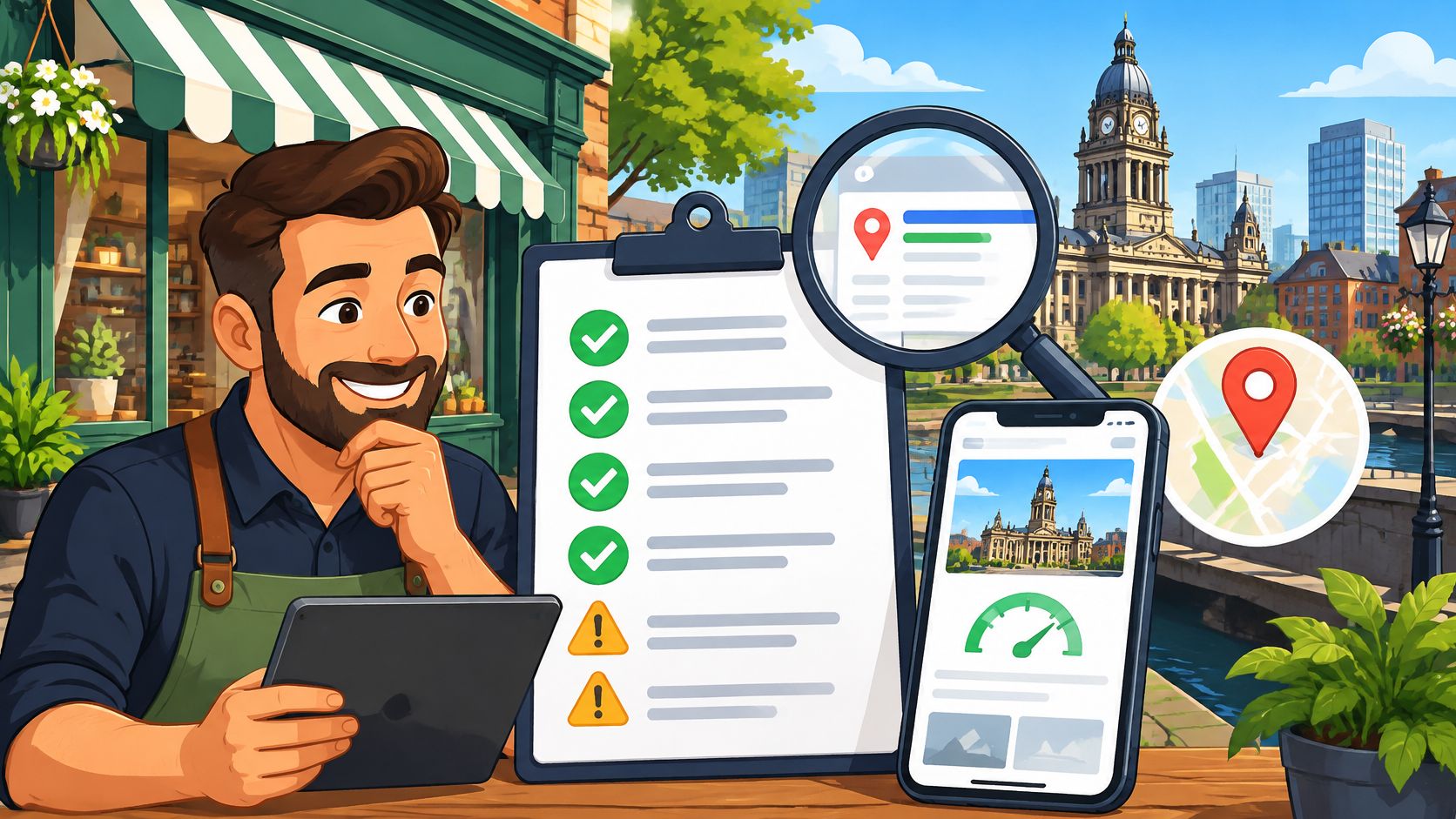
A service page for a Leeds trades firm shows in search. The phone stays quiet. On a smartphone the enquiry button sits under a slow image, and a directory lists hours that disagree with the website. Before paying for more pages, test whether a customer can find the business, reach it, and leave an enquiry that gets recorded.
An SEO audit checklist for Leeds small businesses orders each check by how directly it protects phone taps, form completions and accurate profile details. Broken journeys come first, then visibility, then measurement. A checklist identifies faults worth testing. It does not establish what caused a fall in sales.
I would repair the contact path and matching business details before spending on extra rankings.
Priority Checklist for Leeds Small Businesses
| Check | Pass standard | Where to check |
|---|---|---|
| Mobile usability | Phone number, enquiry button and prices work on a real smartphone | Real phone on mobile data |
| Page speed | LCP at or below 2.5 s, INP at or below 200 ms, CLS at or below 0.1, using the recommended thresholds described in the ONS digital economy research notes | Google PageSpeed Insights, mobile tab |
| Crawling and indexing | Target service pages indexed and not blocked | Google Search Console coverage or Page indexing report |
| Titles and headings | One unique title, one H1 and one search intent per target page | Crawl export or page source |
| Google Business Profile | Category, hours, services and genuine service areas accurate; profile verified | Google Business Profile dashboard |
| Directory consistency | Name, phone and address match across directories where a genuine address exists | Directory listings and citation list |
| Structured data | Business type and visible details match the markup | Rich Results Test |
| Conversion tracking | Calls, form submissions, bookings and purchases recorded as conversions | Analytics conversion reports and call tracking |
| Search features | Local Pack, People Also Ask and reviews checked for each target query | Incognito search for each town and service |
| AI-search data consistency | Business facts consistent on the website, profile and trusted third-party sources | Manual comparison of website, profile, directory and authoritative trade listing |
Weight problems by lost enquiries
Mobile deserves early attention: UK adults spent 75% of their online time on smartphones in May 2024, according to Ofcom's Online Nation report. A desktop-only review can miss the very obstacle preventing a customer from contacting the business.
The table follows the route from accessing a usable page to discovering, checking and measuring the business. Its order isn't an instruction to ignore a wrong telephone number until every heading has been rewritten. Profile accuracy and working call tracking outweigh minor wording changes for a business that earns most enquiries by phone.
Keep the audit proportionate. A plumber serving Pudsey needs clear coverage and an accessible contact route, not a separate near-identical page for every surrounding street. The practical scope of local SEO should follow genuine services and customer journeys.
Practical rule: A failed check is a reason to investigate, not evidence that the fault caused every missing enquiry.
Mark each row pass, partial or fail, attaching a screenshot or test result rather than relying on memory. Count the fails in the first three rows to scope the first fix sprint, while escalating any incorrect contact details immediately. Assign an owner and retest condition to each priority so that completing work means demonstrating a working result, not closing a task.
How to Test Mobile Speed and Usability
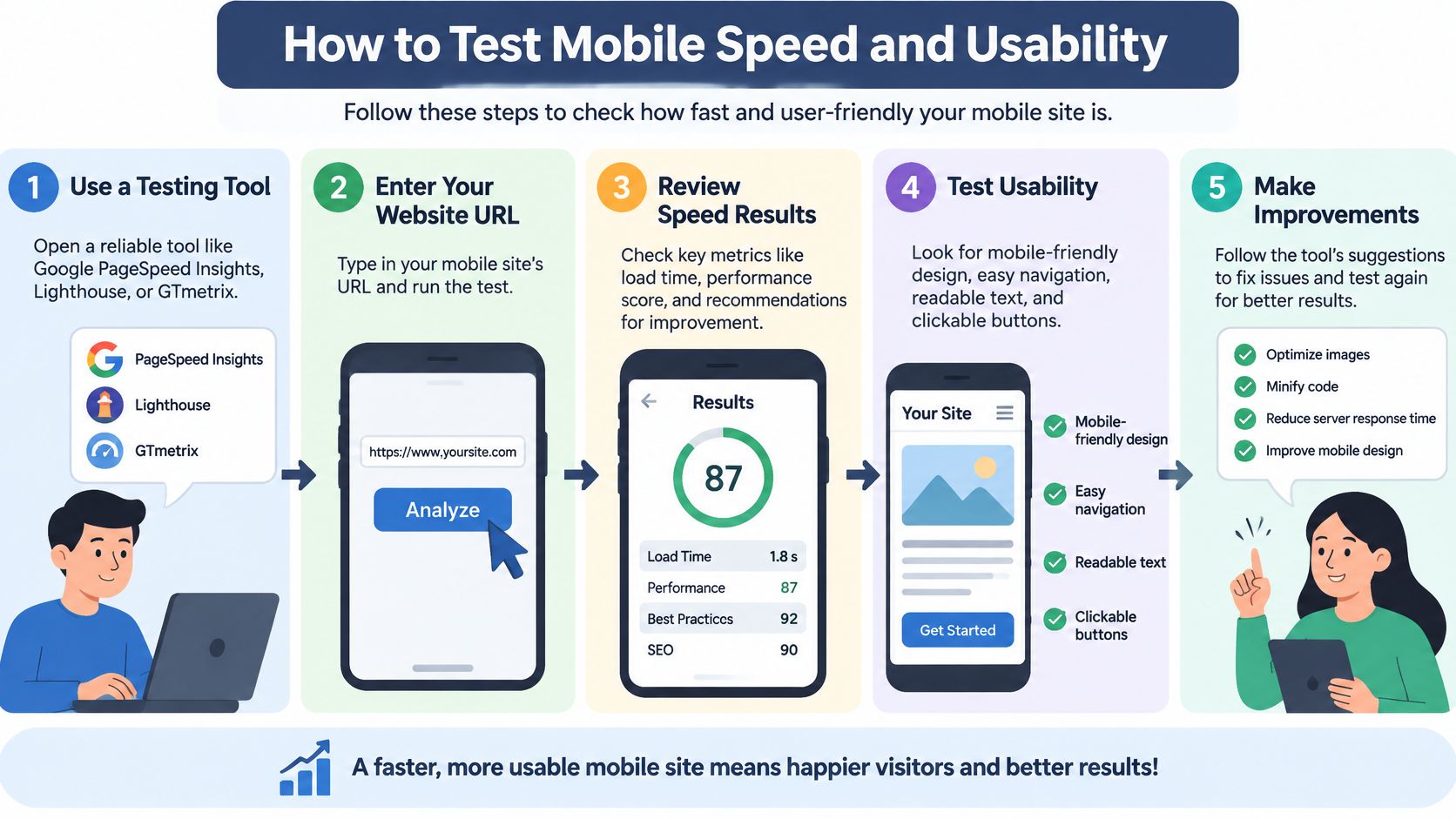
A mobile speed score can't tell whether a customer can successfully request a quote. Test the actual journey as well as loading performance, especially where customers are likely to search while travelling or dealing with an urgent problem.
Run the customer journey
Use a real mobile connection. Load the homepage, main service page and contact page on a smartphone using mobile data rather than office broadband. Include a page customers land on from search, not just the best-looking homepage.
Test the contact controls. Tap the telephone number and enquiry button, confirming that the dialler opens with the correct number and the button reaches the intended form. Check that a cookie banner or sticky menu doesn't cover either control.
Read without zooming. Service names, prices where published and opening hours should be legible at normal size. Open menus and accordions too, since essential information can disappear inside poorly implemented controls.
Measure representative templates. Run Google PageSpeed Insights using its mobile results and record Largest Contentful Paint, Interaction to Next Paint and Cumulative Layout Shift. These describe main-content loading, responsiveness and visual stability respectively; distinguish real-user measurements from simulated test results.
Investigate the failing element. Inspect oversized hero images, third-party marketing scripts and render-blocking CSS before making sweeping changes. Reserve space for banners and images so that buttons don't move just as someone tries to tap them.
Complete an enquiry. Submit the quote or booking form, then confirm that the business receives it and the customer sees an appropriate confirmation. Test validation errors and check that correcting an entry doesn't erase the whole form.
Keep a repeatable record. Log the date, device, connection, page and outcome in a shared sheet. Retest under comparable conditions after a change.
For editorial pages, Blog Health App's resource to test your blog's mobile speed offers an additional starting point for reviewing loading behaviour.
A passing score doesn't excuse a broken form, and a working form doesn't excuse a page customers struggle to load.
A practical pass means key actions complete in a few taps and representative templates meet the checklist's performance standards. Fix the obstructed enquiry before spending development time chasing a perfect cosmetic score.
Technical Foundations for Crawling and Indexing
A Leeds service page can load and still never take a call if Google cannot fetch it. Crawling means fetching the page. Indexing means making it eligible to appear in search. Pages that carry the phone number or the quote form come first in that check.
Check discovery before rewriting content
Inspect the XML sitemap, the file listing important URLs, and robots.txt, which controls crawler access. Confirm that intended service pages appear in the sitemap and are not blocked, then inspect any noindex instructions that would exclude them from search. The AnswerLion sitemap verification guide provides a practical reference for checking the sitemap itself.
Use Search Console's indexing reports and URL inspection on excluded pages. Record why each exclusion exists. Duplicate filter pages may correctly remain outside search, so forcing those URLs in can create more copies of the same thin result.
Check canonical tags, which identify the preferred version of duplicate pages. Confirm that live pages return a successful HTTP status, while retired addresses redirect to a relevant replacement or return an appropriate missing-page response. Test whether service-area content and internal links remain discoverable without relying entirely on JavaScript. If the blocked or orphaned URL is the one customers use to enquire, that repair sits ahead of title edits.
Give each commercial page a clear purpose, an informative main heading and a specific meta description. The same generic text on every area page makes it harder to see which URL should earn the click.
Separate duplication from useful inventory
For retailers, inspect faceted navigation, such as colour and size filters, for unnecessary duplicate URLs. A discontinued product should not display an empty error message while returning a successful page response, commonly called a soft error. Those URLs spend crawl attention that should stay on pages people can still buy from or enquire about.
Check structured data, the machine-readable description embedded in a page. Business type, name, address and opening hours must agree with visible content. Run applicable pages through the Rich Results Test and remove unsupported details. A mismatched address or the wrong opening hours can send someone to a closed premises, which costs the enquiry before any snippet styling matters.
For a straightforward small site, a sensible low-effort repair sequence is:
- Status and redirects: Repair broken destinations and incorrect responses on pages that should take calls or form submissions.
- Canonical clean-up: Consolidate unintended duplicate versions so one URL carries the enquiry path.
- Titles and headings: Rewrite unclear page labels once the correct URLs are established.
Platform limitations can change that effort order. A confirmed site-wide indexing block takes precedence over every cosmetic improvement.
Check Local Visibility and Google Business Profile
Someone searching boiler repair Leeds can call a business from the map without ever opening the website. The Local Pack, the map box commonly showing three businesses, often sits above ordinary organic results. A useful site still loses the enquiry if the number, hours or coverage shown there are wrong.
Results pages commonly place a map, reviews, images or questions around the standard links. Read the whole page for the query in front of you. Feature mix changes by search, so a national pattern is a poor substitute for the Leeds terms that bring calls.

Inspect the searches customers make
Test combinations such as boiler repair Leeds, dentist Chapel Allerton and wedding venue near Leeds in an incognito window. Incognito reduces some personalisation. It does not remove location effects, so write down the search location and the device next to each result.
Note whether a map result, review, image or People Also Ask question takes the prominent space. If a question matches buying intent, check that the relevant page answers it in plain terms. An unrelated FAQ added only to repeat keywords does not protect the enquiry.
Review the profile and supporting facts
I would fix profile accuracy before treating rank movement as progress. Category, phone number, hours and service area decide whether a map impression becomes a call, a direction request or a form completion.
Check the primary category against the main business activity, then review secondary categories, services, photographs and opening hours. Compare the profile with Google's Business Profile guidelines. Use genuine service coverage, and do not invent a premises the business does not have.
The Google Business Profile optimisation guide for Manchester businesses is a process reference. A Leeds audit should use this business's own services and coverage, not wording copied from another town.
- Reviews: Check that replies address customers appropriately and that invitations go to all customers, without satisfaction-based gating.
- Directories: Correct business-name, telephone and genuine-address mismatches at their original source.
- AI-search facts: Compare service areas, hours, qualifications and policies across the website, profile and established third-party listings.
Read any AI-generated description for factual errors. A mention is not a qualified lead. Matching facts across those sources makes the business easier to verify when a customer, or a results feature, looks it up.
For each query, record position, competing business, feature shown and any enquiry evidence you can tie to it. Calls and direction requests are often reported in aggregate, not against one exact query. Mark attribution as unavailable rather than guessing a ranking win from a phone tap.
Measure Enquiries Rather Than Rankings
Unreliable measurement can lead a business to cut useful activity or fund ineffective campaigns. The UK Government's Online Advertising Taskforce progress report states that online advertising accounts for £4 in every £5 of advertising budgets, making dependable reporting a practical spending safeguard.
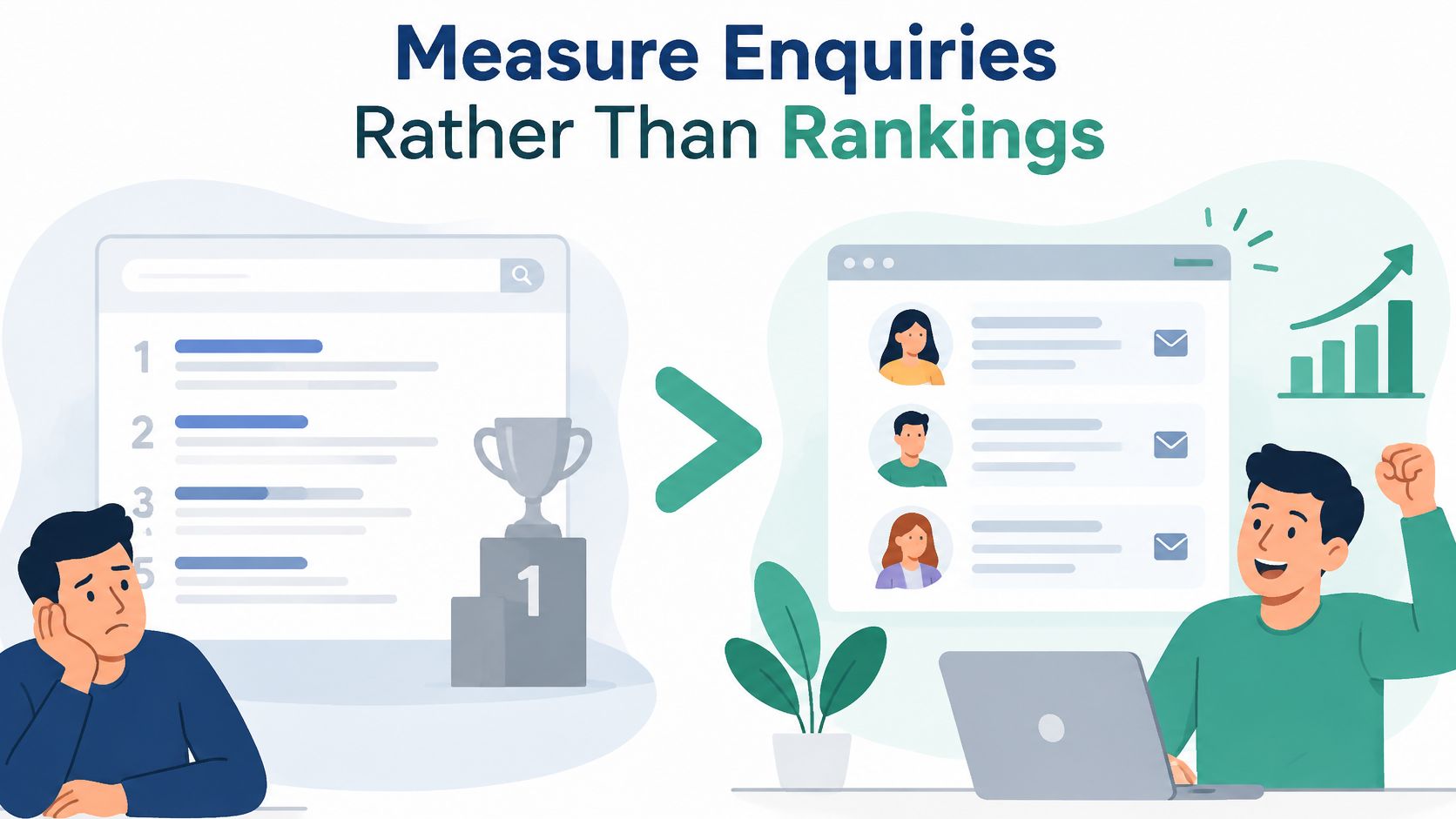
Define conversions before judging performance. Phone clicks, successful form submissions, booking requests, quote requests and completed purchases belong in the conversion framework; page views, scrolling and brief interactions don't belong in the primary lead total.
Distinguish an interaction from an opportunity
A telephone tap signals intent, not a completed conversation. Keep it separate from answered calls and qualified enquiries, and distinguish a booking request from a confirmed booking. Otherwise, several actions by the same customer can inflate the apparent return.
Test call tracking and form events for duplicate firing. Record successful submissions rather than clicks on the submit button, and check that refreshing a confirmation page doesn't create another lead.
Apply campaign tags consistently across advertising and email where appropriate, without disrupting native advertising attribution. Reconcile analytics with enquiry records and completed orders, allowing for consent choices and other measurement gaps.
Measurement caution: More clicks without more enquiries identifies a question to investigate, not proof that the traffic is worthless.
Compare paid-search cost per qualified enquiry with organic enquiry volume and conversion rate over matching periods. The decision between SEO and Google Ads becomes clearer when both channels use the same definition of a useful lead.
Keep the monthly report commercial
- Qualified enquiries by source: Separate suitable prospects from spam, suppliers and irrelevant requests.
- Cost per qualified enquiry: Include the relevant channel costs, not just an advertising platform's reported lead total.
- Landing pages by enquiry rate: Investigate pages attracting relevant visitors who don't progress.
For ecommerce, reconcile transaction values, cancellations and refunds with order records. Unclear delivery costs, unavailable products, checkout friction and broken tracking require different fixes, even when they produce similar-looking charts.
Worked Examples of Audit Priorities
The same checklist should produce different decisions depending on how a business earns enquiries. The following examples are hypothetical illustrations, not client results.
| Business type | First audit priority | Monthly measure |
|---|---|---|
| Hypothetical plumber, Headingley and Horsforth | Profile service areas, Local Pack presence and call tracking | Calls and direction requests by query where attributable |
| Hypothetical solicitor, Leeds city centre | Practice-area page headings, People Also Ask answers and form conversions | Qualified enquiries by practice area |
| Hypothetical online retailer, Leeds, Bradford and Wakefield | Mobile checkout speed, stock status and retired URL status codes | Checkout completion and revenue by landing page |
| Hypothetical restaurant, Leeds | Opening hours and directory consistency | Table bookings and direction requests from profile |
Urgent calls versus considered enquiries
A hypothetical plumber serving Headingley and Horsforth finds unclear coverage on the profile and no meaningful visibility for emergency searches. Correcting that profile and confirming call measurement would come before publishing general maintenance articles. Service pages should then address genuine gaps in the searches that matter, rather than multiplying town-name variants.
The local SEO guide for tradespeople in Oldham offers a useful trade-focused comparison of priorities, but the search terms and coverage must remain specific to the Leeds business.
A hypothetical city-centre solicitor has a different problem: practice-area pages describe the firm but don't answer prospective clients' questions. Direct answers about process, suitability and fees where appropriate would support the enquiry decision. Form completion and qualified enquiries should then be recorded by practice area, rather than combined into a single undifferentiated total.
Transactions versus visits
For a hypothetical retailer serving Leeds, Bradford and Wakefield, a slow mobile checkout deserves attention before a larger content programme. Review indexed out-of-stock pages individually: temporary unavailability doesn't automatically justify removing a useful product URL. Permanently retired products need an appropriate status or a relevant replacement.
A hypothetical Leeds restaurant has inconsistent opening hours across listings. Correcting those details comes before expanding editorial content, because customers need dependable information before travelling or booking. Booking confirmations and profile interactions can then be reconciled with actual reservations.
These examples show how the enquiry path changes the order of work. A live audit still needs the site's own evidence, available development resources and business priorities before anyone can identify the most valuable repair.
Book Your Free Leeds SEO Audit
A Leeds tradesperson can sit near the top of local results and still miss the job when the profile phone number is wrong or the mobile form stalls. I would put those checks first. A checklist flags problems. It does not prove which fault is costing enquiries.
If the first three checklist rows can't be marked as passing, a conversation about priorities is more useful than another unranked error report. Bring the website address, Google Business Profile details, target services and a short list of important searches.
Google Ranker Pro starts with the website and its goals, then discusses the main areas worth investigating. The free SEO audit is a starting conversation, not an automatic live scan. Make access issues, missing tracking or uncertain business details clear at the outset.
The broader SEO services set out work that may follow, but the immediate task is choosing what protects phone taps, completed forms and profile accuracy before rankings alone. Google Ranker Pro is independent of Google and does not guarantee rankings.
Request a free SEO audit or discuss your requirements. Google Ranker Pro uses that free review as a starting conversation on search visibility, enquiry journeys and the next priorities.