
GOOGLE RANKER PRO / INSIGHTS
Choosing Google Business Profile Categories for York Hospitality Businesses
Choose the right Google Business Profile categories for York hospitality businesses, with a decision table for hotels, pubs, cafés and venues.
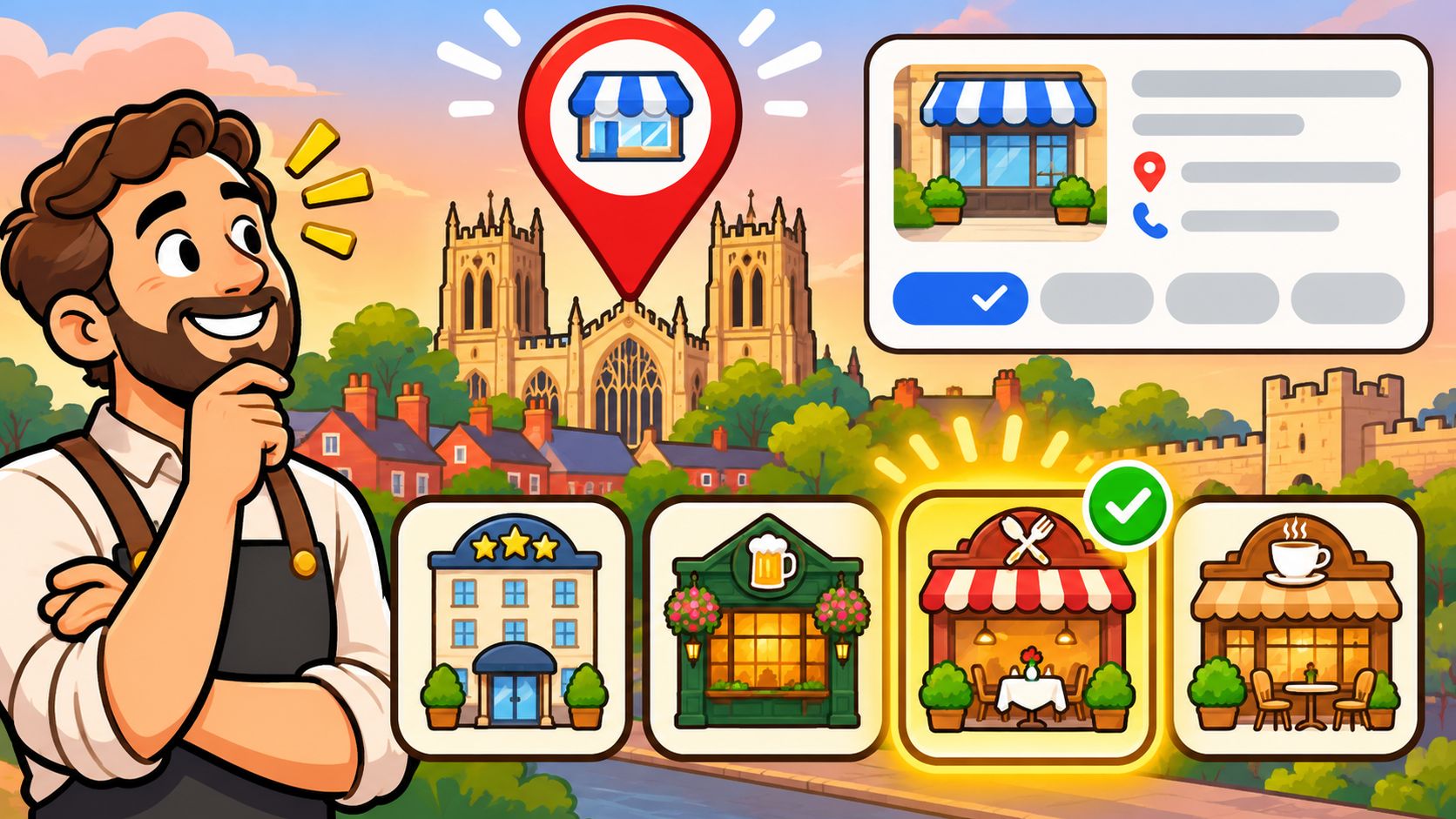
Which Google Business Profile category should a York venue choose when it sells rooms, Sunday lunch and wedding receptions from the same building? The answer most operators reach for, list every category that might match a search, is the one that damages a profile. Google's category list is fixed and descriptive, and the field does one job: it tells the search engine what the business is.
York makes that choice harder than most cities, because one visitor economy supports three separate search journeys. Someone needs a bed for three nights. Someone else wants dinner near the Minster at seven o'clock. A third person is hunting for a café to sit out a wet afternoon. City-wide figures show how distinct those demands are, and why a venue trying to answer all three with categories ends up describing none of them properly.
The method below is deliberately boring. Match the category to the intent that pays the bills, use secondary categories sparingly, audit what you already have, then review quarterly instead of every time occupancy dips.
Primary Category Picks for York Venues at a Glance
Start with the table. It takes under a minute to find the row that describes your venue, and it settles the question most operators get wrong before they think about keywords at all.
| Venue type | Primary category to test | Secondary only if material | Avoid as primary |
|---|---|---|---|
| Hotel with overnight rooms | Hotel | Restaurant or Bar if dining runs as a real service | Amenity tags such as Breakfast or Parking |
| Bed and breakfast or guest house | Bed & breakfast (confirm the closest option in your list) | Event venue if functions run regularly | Hotel, if rooms are only occasional |
| Restaurant | Restaurant | Bar if drinks service is substantial | Cuisine labels that describe menu items rather than the business |
| Pub | Pub | Restaurant if food is the principal offer | Bar, if food drives most visits |
| Café | Cafe | Bakery only if baking is sold as a main line | Breakfast or brunch as a primary category |
| Wedding venue with overnight stays | Wedding venue | Event venue, Hotel only if rooms are substantial | Caterer or florist as primary |
| Visitor attraction with a café | Tourist attraction | Cafe only if it trades with its own hours | Cafe as primary when visitors come to the attraction |
Google doesn't allow custom categories. You select from a predefined list, and its guidance is to choose the most specific option available, because the category functions as a relevance signal rather than a label you can decorate (Google's category guidance). A hotel selling overnight rooms tests the hotel category first. A restaurant-led venue tests the restaurant category first. Everything else describes a related business, not yours.
For venues the table misses, one question decides it. If removing a category would make your profile describe a different business, it is your primary category. If removing it still leaves an accurate description, that category belongs in secondary categories, or nowhere.
Read the rows with that test. A guest house letting rooms only in summer isn't a hotel. A pub where food is the main draw isn't best served by Bar. A café inside a museum isn't a café business, it's an attraction with a café, and the profile should say so.
Treat the table as a starting point rather than a verdict. It tells you which category to test, not which one Google will reward. The same discipline travels well beyond Yorkshire, as this walkthrough of Google Business Profile optimisation for Manchester businesses sets out.
Mixed-Use Venues and When a Separate Profile Makes Sense
Combined venues carry the hardest decisions, and three questions resolve nearly all of them.
Which activity drives the main customer intent? Not the full range of facilities, not the part of the building you're proudest of. The activity that generates most bookings and most revenue.
Could the department run independently? Its own hours, its own entrance, its own staff, its own booking system. A restaurant inside a hotel that takes separate reservations and has a street door is closer to a separate business than a breakfast room that only serves guests.
Would a visitor search for it on its own? People search "restaurant in York" and "hotel in York" as different journeys. If nobody would ever type the department's name or service separately, it doesn't need its own category structure.
Google's guidance points the same way: use as few categories as possible, pick the most specific one for the core business, and avoid categories describing related businesses or attributes (Google's guidelines for representing your business). A venue claiming to be a hotel and a restaurant simultaneously usually ends up half-relevant for both.
Worked example, hypothetical: a 20-room boutique hotel in York with a restaurant open to non-residents keeps Hotel as its primary category. Dining is described through services, menu content, photos and one eligible secondary category. It doesn't try to run two profiles from one address, and it doesn't swap its primary category to Restaurant for the summer.
| Scenario | Primary category | Separate profile needed? | Deciding question |
|---|---|---|---|
| Boutique hotel with restaurant open to non-residents | Hotel | Usually no; describe dining through services and menu | Do rooms generate most booking intent? |
| Pub with letting rooms | Pub, or Hotel if rooms lead revenue | Only if rooms run as a distinct business | Which search would a visitor type first? |
| Visitor attraction with café | Tourist attraction | Only if the café has its own hours and entrance | Would someone search for the café alone? |
| Wedding venue with overnight stays | Wedding venue | Rarely; cover stays through services and photos | Are weddings the main booking route? |
| Serviced accommodation | Closest accommodation category, Hotel if run like a hotel | No | Is it run as a hotel-style service with reception and housekeeping? |
A separate profile is justified in one narrow case: the department trades under its own identity, with its own name, hours, staff and customer relationship. Anything short of that fragments your reviews and splits the signals that make one profile credible. The Habbibi Manchester case study shows how a hospitality venue's presentation, rather than category stacking, carries the impression.
How to Audit Your Current Categories in Six Steps
A York pub can still carry a festival category from a one-off weekend three years ago, while overnight guests search for rooms and day visitors search for lunch. That leftover category is clutter beside the primary that should match the searches the venue wants. The audit below takes about an hour and leaves a written baseline you can compare next quarter.
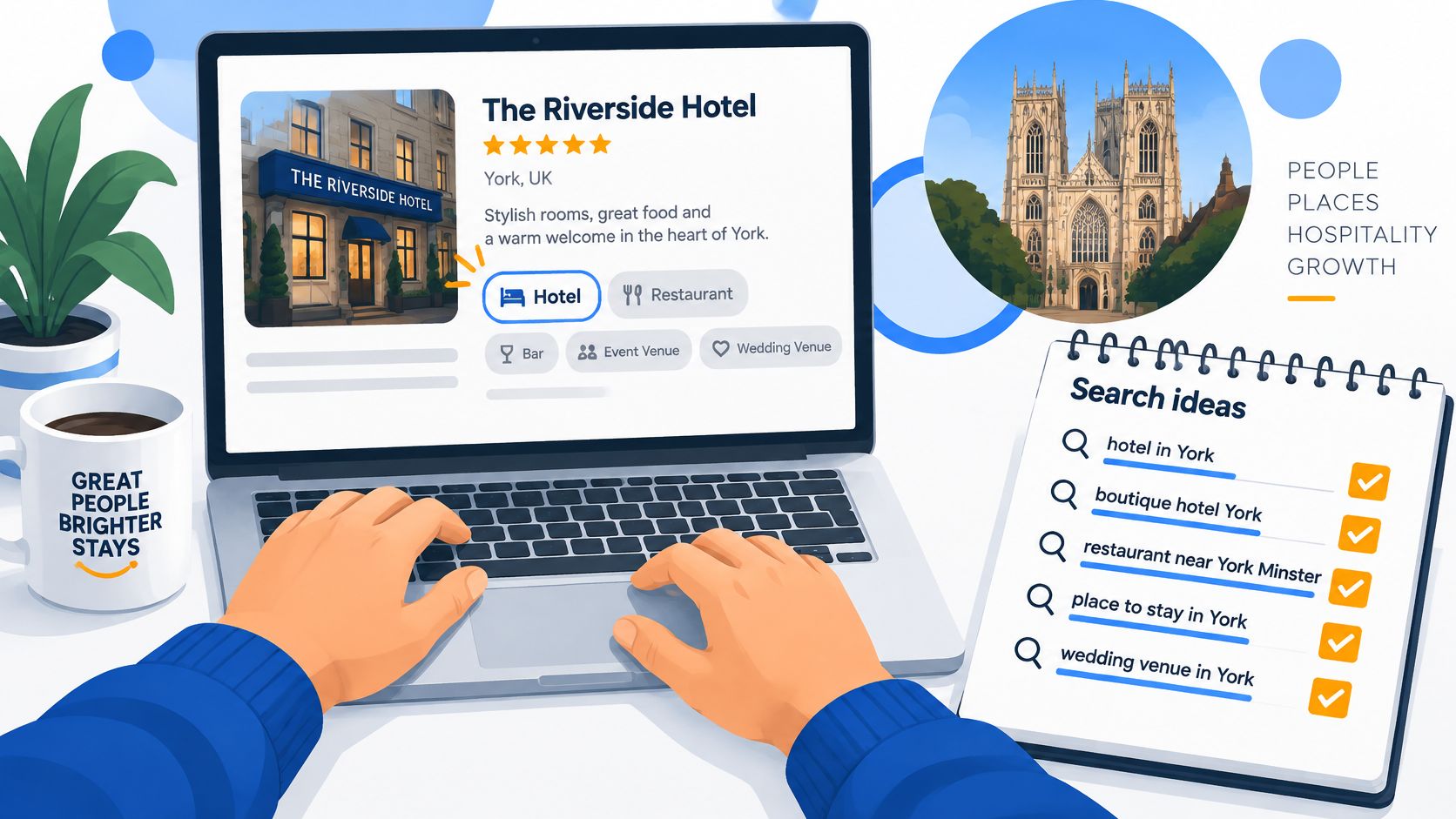
1. Write down what you currently have. Open the profile and record the primary category plus every secondary one. Memory misses the old festival tag. A written list makes the next change visible.
2. Sort five visitor searches into overnight, dining and day visits. Overnight: "hotel in York", "pub with rooms York". Dining: "restaurant near York Minster", "afternoon tea York". Day visits: "York wedding venue". Use phrases a visitor would type, not phrases you wish you ranked for. York produces all three kinds of demand, so one category rarely covers the mix. Set the primary to the pile that drives most bookings. Use a secondary only for a real second service.
3. Run each search from several York locations. Results shift with where the searcher stands, so test from the centre and from Acomb, Haxby, Selby, Tadcaster, Malton, Pocklington and Easingwold. Note which businesses appear, and which categories they use, for each of the three search types.
4. Compare your primary category with theirs. If the venues showing for your most valuable search share one category and you use another, understand that gap before you change anything. A category change can alter which of those searches you appear for. It does not promise a ranking movement.
5. Remove secondary categories that describe amenities or menu items. A category for something you sell as an add-on, rather than a service you run, adds noise. Cut festival, menu-item and one-off event categories unless they still describe how you trade every week.
6. Add only defensible secondary categories. Google's category-management guidance allows up to nine additional categories, and treats them as optional, so a short accurate list beats a long one (Google's category guidance). I would add a secondary only when it names a service you offer, such as dining at a hotel or rooms above a pub, and only when that service has its own demand in the three piles above.
To make the change, open the category field, search the live list for the closest match and save. Log the date and the old value so the next review shows what was tested. The same evidence-first habit sits behind this SEO audit checklist for Leeds small businesses.
Restaurant Hours, Menus and Ordering Fields to Check
The category says what the business is. The fields around it say how a customer can use it, and in York's dining market the second part is where most lost bookings sit. Five checks cover it.
- Standard opening hours, correct for every day. A visitor planning a Monday lunch will skip a listing showing Sunday hours with no update.
- Additional hours for delivery, takeaway, drive-through and collection. Google lets restaurants separate these from dining hours, and they should stay separate, because a collection customer arriving during dining-only hours leaves without food (Google's restaurant guidance).
- Special hours for bank holidays, events and exceptional closures. Christmas opening, race days, a private function closing the dining room: each needs a dated entry rather than a guess.
- Online-ordering links, tested. Click the link yourself on a phone. A provider page pointing at last year's menu costs you the order at the final step.
- Menu sections, dishes, descriptions, prices and menu photos. Match the website menu, and refresh when prices change. Reserve with Google is worth enabling where your booking system supports it.
Say a York restaurant lists its lunch service and Friday dinner correctly but has no takeaway hours at all. Every evening search for collection returns a business that appears closed for that purpose, even though the kitchen is running. The fix is a two-minute edit.
If you're resetting the whole listing rather than just the category, 10Seat's restaurant profile setup guide works through the fields in a sensible order.
The closing test is simple. Reading the profile alone, a stranger should know what to order, when to arrive and how to book. If any of the three needs a phone call to confirm, the fields aren't finished.
Visitor Demand Signals Behind York Category Choices
Category decisions should follow the shape of demand, and York's demand is documented. In 2024 the city attracted 9.4 million visitors and tourism contributed £2.01 billion to the local economy, a 5.4% increase on 2023. Staying visitors reached 1.7 million and remained for an average of 3.3 nights. Accommodation received 25% of visitor spending and food and drink 27%, so the two hospitality segments together took 52% of the total (Visit York).
The following year's reporting puts the visitor economy at £2.08 billion, with 8.88 million visitors including 1.87 million overnight visitors; domestic visitors generated £1.5 billion and overseas visitors £570 million (York Press). Earlier council evidence found eating and drinking was the most popular activity among leisure visitors, chosen by 96% (Visit York). These are city-wide figures. They say nothing about how one venue performs.

The practical read is straightforward. Overnight guests search around rooms, availability and location. Diners search around cuisine, meal occasion and opening times. Your primary category should follow whichever of those brings in most of your revenue, and the rest belongs in services, attributes, photos and menu content. If most of your bookings are beds, don't run a restaurant primary category because the kitchen is busy.
Correction worth making once: overseas visitors don't need a different category. They need descriptions, booking information and location context that read clearly in international English.
Demand moves through the year, and Visit York's tourism intelligence programme tracks hotel and short-let occupancy, average room rates, attraction visits, website sessions and city-centre footfall. Watch those indicators to time seasonal services and promotions. Changing the primary category each season only confuses the signal, and operators who want more of that demand booked directly should read this guide to driving direct bookings with local search. The wider framework sits in this guide to local search.
Quarterly Review and Next Steps
Has the balance of overnight stays, dining and day visits shifted since you last chose the primary category? A fixed review, roughly every three months, is the way to catch that before the profile describes last season's business.
- Confirm standard hours, then add special hours for bank holidays, events and exceptional closures.
- Update seasonal services such as afternoon tea, terrace dining or wedding packages, so the profile matches what you currently sell. If day visitors now fill more tables than overnight guests, those services should be visible.
- Refresh photos and the business description when the offer changes, and check they agree with the website.
- Recheck delivery, takeaway and collection hours against the ordering journey. Provider links break without warning.
- Confirm the primary category still matches core activity. I would leave it alone unless the business itself has changed, for example a rooms-led hotel that now takes most of its money from the restaurant. Then rerun the five test searches and remove any secondary category you can't defend.
Google Ranker Pro is an independent UK agency, not affiliated with Google, and its Local SEO plan for local service businesses includes Google Business Profile optimisation at a guide rate of £747 per month, with York and nearby Yorkshire towns among its service markets.
If you'd rather hand the audit over, or talk through requirements, get in touch. The York Cars private hire project covered service information and booking routes, search and reputation support, plus fleet photography and social assets. Visit Google Ranker Pro for how that local SEO work is set up for hotels, restaurants, pubs and visitor attractions.