

A customer has found the business online, but the phone number belongs to an old line and the map points to a former workshop. For a Rochdale business owner, the immediate problem isn't finding more directories. It's establishing which listings describe the business accurately, which describe a genuine trading location, and which shouldn't be there at all.
Meta description: Run a practical local citation audit for Rochdale businesses, checking trading locations, contact details, duplicates and enquiry measurement.
Why Rochdale Listings Drift Out of Date
Consider a hypothetical Rochdale plumber whose workshop moved to Milnrow. A directory still displays the former street address, a retired telephone number and Saturday opening hours that no longer apply. The business is trading normally, but a prospective customer encounters information that suggests otherwise.
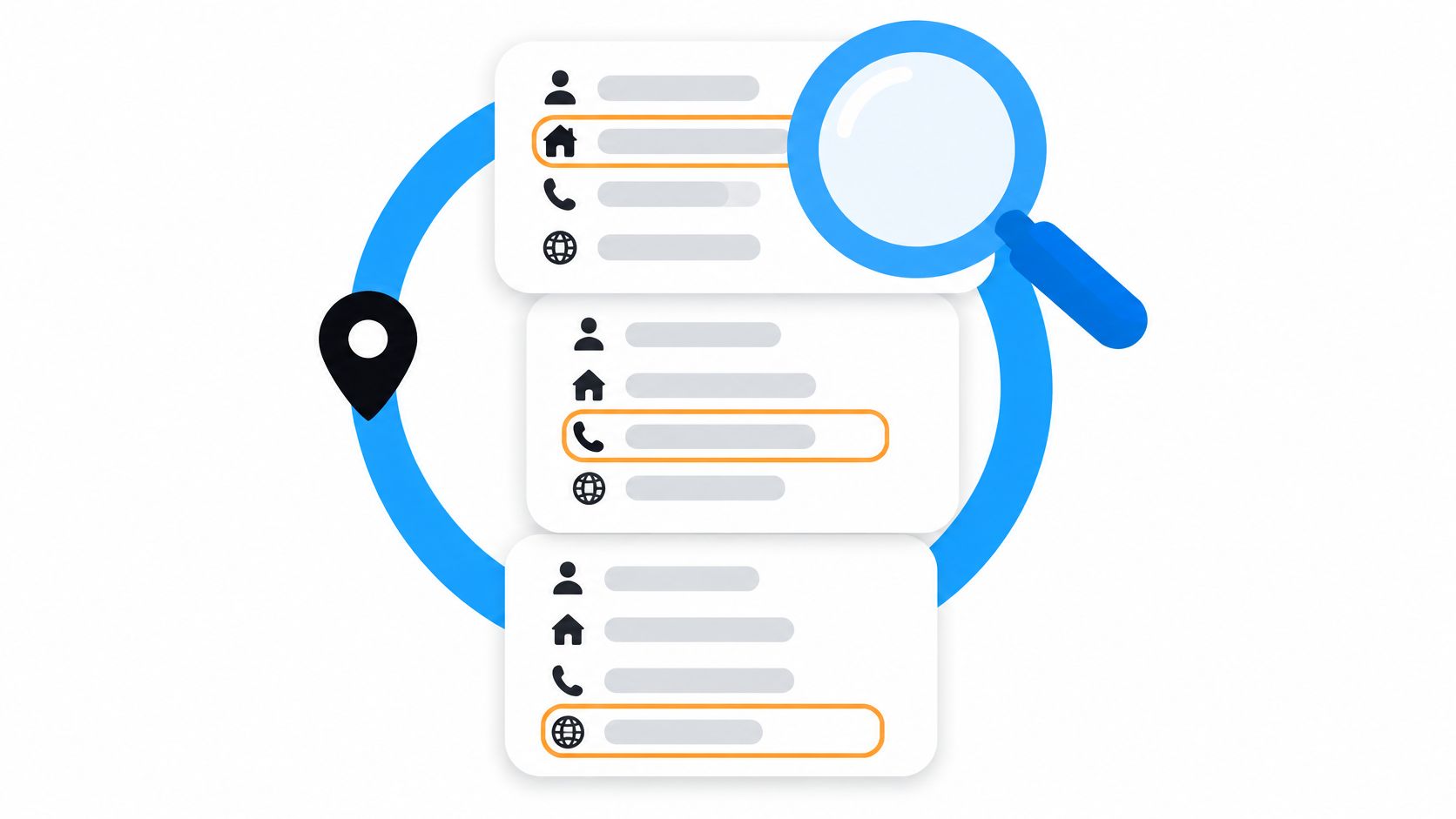
A local citation audit for Rochdale businesses is a field-by-field check of online business mentions, followed by a recorded correction process. A citation typically contains the business's name, address and telephone number, abbreviated to NAP. The audit should also cover the website, hours, category and contact route across directories, map platforms, trade bodies, council or chamber listings and sector sites.
Start with the location, not the directory
The Office for National Statistics business activity bulletin defines a local unit as an individual site, such as a shop, factory or other premises, within an enterprise. A company and its operating sites therefore aren't interchangeable.
A service-area business may have no customer-facing premises. Its audit should cover Rochdale and the places where it takes work, potentially Heywood, Littleborough, Middleton and Norden, without describing those service areas as offices.
Practical rule: Establish what each listing represents before deciding whether its details are correct.
Listings drift when owners move, change numbers, rebrand or leave directory accounts untouched. Previous agencies and automated imports can also leave competing versions online. The commercial priority is straightforward: someone searching on a phone may call or travel immediately, so an obsolete number or misleading opening time can prevent an enquiry before the business knows it existed.
Build a Canonical Record and Find Every Listing
Create a canonical record, the reference copy against which every listing will be checked. Start with an export or saved copy of the Google Business Profile details, but verify those details against the business's actual operations rather than assuming the profile is correct.
The record should distinguish the legal name from the customer-facing trading name. It should also explain which information belongs in public listings and which is retained only for administrative verification.
Establish the reference copy
- Business identity: Record the legal name, verified trading name and any former names that may help uncover stale records.
- Contact details: Confirm the main telephone number, live website and working contact route.
- Operating arrangements: Record regular hours, genuine service-area towns and whether customers can visit.
- Location evidence: Include the exact premises address where appropriate, with its unit, building identifier and postcode.
Validate postcodes against the ONS Postcode Directory, which connects current and terminated UK postcodes with administrative and statistical geographies. A valid postcode helps verify the address structure; it doesn't establish that the business occupies the premises.
Build the discovery log
Search separately for the trading name, former name, telephone number, website domain and postcode. Check map platforms, major UK directories, relevant trade databases and local community or chamber records. Searches using an old number are particularly useful for discovering forgotten listings.
For each result, record the source name, listing URL, date checked and apparent location type. Add ownership access, editorial contact details and any stated inclusion or duplicate policy.
For businesses assessing outside help, Free AI Directories' local citation services for AI tools can provide a starting point for identifying services to investigate. Assessment should still focus on coverage, correction methods and account ownership, not directory volume.
Unconfirmed information stays unverified. Guessing a postcode, address or opening time creates another version that later needs correcting.
Sort Listings by Trading Model Before Editing
| Listing type | Typical example | Correct action |
|---|---|---|
| Customer-facing premises | Shop or workshop that receives callers in Rochdale | Keep, then verify hours and map pin |
| Staffed branch in a nearby town | Office in Oldham or Bury with its own staff | Keep as a separate location with its own details |
| Service-area business | Mobile trade covering Rochdale and Littleborough from a home base | Show the service area; don't publish a home address where rules don't allow it |
| Registered office only | Companies House address for a company with no public premises | Remove or correct the trading-location claim; never present it as a trading site |
| Obsolete or duplicate | Old address after a move, or a second profile for the same trade | Close, merge or request removal |
The listing type and the action to take should be settled before editing individual fields. The UK government's guide to business statistics distinguishes registered businesses counted by head-office location from local sites representing operating locations. That distinction provides a useful audit framework.
Apply the customer-visit test
Could a customer visit the address and receive the advertised service there? If not, the address shouldn't be presented as customer-facing premises merely because it appears in an official company record.
A registered-office entry may be entirely correct in a legal register. It doesn't need deleting because the company trades elsewhere. The correction belongs wherever that address has been repurposed misleadingly as a shop, branch or public office.
Take a hypothetical electrician based at home in Littleborough who works at customers' properties across Heywood, Middleton and Milnrow. The appropriate public description is the genuine service area, subject to each platform's address-display rules, rather than an invented staffed Rochdale office.
An official correspondence address isn't automatically a place where customers can be served.
For a genuine branch, retain its separate identity and local contact details. For a mobile business, check hidden-address and service-area settings before publishing anything. Adding a Rochdale address solely to appear local creates a claim the business may be unable to verify and can conflict with platform eligibility rules.
Audit Scorecard Checks Every Listing Field
| Field | What to check | Pass condition | Common fault |
|---|---|---|---|
| Business name | Trading name against registered name and signage | Matches the canonical record exactly | Old trading name or added keywords |
| Address or service area | Building or unit, street, town and postcode | Matches verified premises or declared service area | Registered office shown as a trading site |
| Telephone | Full number including area code | Matches the canonical main line or documented approved tracking arrangement | Former number still live |
| Website | Root domain and main contact page | Points to the live site over HTTPS | Old or parked domain |
| Opening hours | Regular hours and holiday changes | Matches published hours | Seasonal hours left unchanged |
| Primary category | Main trade or service category | Matches the service the business delivers | Generic or wrong category |
| Map pin | Position on the map | Sits on the correct premises, or service-area display is appropriate | Pin on a neighbouring street or business |
| Duplicate profile | Same business listed more than once | One profile per genuine location, subject to platform exceptions | Second profile with outdated details |
Use this citation audit scorecard as a working record, not a vague quality score. Each available field receives a pass or fail against the canonical record, with the listing URL and check date attached. Where a platform doesn't offer a field, mark it as unavailable rather than treating the omission as an error.
That discipline matters because local listings often combine facts from different sources. A name may come from signage, a registered address from company records and a category from a directory template. The scorecard keeps those inputs separate so a correct item in one field doesn't hide a misleading claim in another.
Identity and contact checks
Compare the trading name with the name customers encounter on signage, stationery and the website. Keep the legal entity separately where a directory requests it. Added service keywords shouldn't be accepted merely because an earlier agency inserted them.
For the address, check whether the listing describes the correct operating arrangement before checking spelling. A perfectly transcribed registered office still fails if it's advertised as a public workshop. A mobile service area also fails if it has been converted into a physical Rochdale premises that the business cannot verify.
The telephone and website rows should be judged against the canonical record: main line or documented approved tracking arrangement, plus the live site over HTTPS. Record the exact value shown in the listing. If it differs, note whether it is an old number, a parked domain or a page that no longer represents the business.
Availability and discovery checks
Hours should describe when the advertised service is available, not when someone answers administrative email. Distinguish a staffed reception from an appointment-only service and record holiday exceptions where supported. This keeps the listing aligned with how customers use the service.
Choose the closest available category to the principal service. Directory categories won't always match word for word, so assess meaning rather than demanding identical labels. A generic category can bury a specialist trade among unrelated results, while an inflated category can promise work the business doesn't deliver.
Inspect the map visually. A postal address may be correct while the pin sends visitors to another entrance or neighbouring premises. For service-area profiles, don't invent a public pin just to complete the scorecard. An unavailable or hidden-address setting is a valid result when it reflects the trading model.
Investigate apparent duplicates before requesting removal. Similar names may represent separate branches, while different names may conceal an old version of the same business. Check the address arrangement, contact details and service description together, since one shared field can explain the duplication.
Count failures by field across the log to see whether the problem sits with one source or repeats across the business. A single directory may need a correction. Repeated failures in name, category and service-area fields point to a canonical record or trading-model issue that should be fixed first.
Verify Address and Contact Details Line by Line
A former building name attached to the right postcode can still create a misleading citation. The fix is to compare each field with the verified trading record, then keep the original wording in the audit log so the correction is easy to trace. The government practice guide on addresses for service requires a complete UK postal address, including the postcode, in its specific legal context. That legal context differs from directory rules, yet it supports a practical habit: keep the building identifier and postcode visible in the record.
Record the exact discrepancy
- Building identifier: Check for a former building name or a missing street number.
- Unit or suite: Confirm the occupied unit, especially in shared offices and industrial estates.
- Street: Record spelling differences and omitted street elements, while treating harmless format changes as a lower-priority issue.
- Town: Establish whether the premises are in Milnrow or Littleborough rather than casually replacing the town with Rochdale.
- Postcode: Check for transposed characters and confirm that the code remains current.
Worked example: a listing shows an old building name, the correct street and the correct postcode. The resolution is to replace only the building identifier with the current verified name, keep the postcode, and record the old value as a former name in the log. That avoids creating a new address that looks tidy but cannot be confirmed.
The same care applies to distinct contact details. If a directory uses a tracking line, record it as intentional and make sure calls still reach the right business. If it shows an unexplained main-line replacement, treat it as a reporting problem and correct it from the canonical record.
For mobile businesses, stop the address check at eligibility. A home base that doesn't receive customers shouldn't become a public trading-location citation merely to make the address fields look complete.
How to Correct and Prioritise Listings
Correct the records that customers are most likely to act on before spending time on obscure directories. The UK government's online-search literature review provides historical context for the importance of mobile discovery. The practical issue remains the route from a search result to a call, visit or booking, not the size of the submission list.

Work through the correction queue
- Fix the verified baseline first. Correct identity errors on the Google Business Profile and the website using the canonical record. Google's Business Profile guidelines require accurate business information, so eligibility and real-world representation take precedence over keyword targeting.
- Correct prominent customer routes. Prioritise major map and search listings, visible UK directories and sector bodies that prospective customers use. A broken number deserves attention before an optional description field.
- Resolve duplicates through platform procedures. Claim, merge or request removal as appropriate. Check ownership and review implications before deleting anything.
- Close misleading historical records. Address former premises and registered offices wrongly advertised as trading sites. Where relocation support exists, use it rather than creating an unrelated replacement profile.
- Assess lower-value directories selectively. Retain relevant geographic or trade coverage, but don't pay for broad submission to increase a count.
- Record the outcome and next check. Log the platform, submission date, requested change, evidence supplied and eventual published result.
Before action begins, classify records as correct, incomplete, duplicated or inaccessible. A submitted edit isn't a completed correction: the public-facing listing needs checking after the platform processes it.
Priority test: Fix the error most likely to prevent a genuine customer from making contact.
An inaccessible listing may require an ownership recovery or editorial request. Keep that work separate from straightforward edits so an unresolved account doesn't hold up the entire audit.
Re-Audit and Measure Whether Corrections Work
Use a quarterly review, with an immediate check after relocation, a telephone change, rebranding, altered service coverage or closure. Keep the correction log open until changes are visible publicly. Rejected edits, recurring duplicates and records that revert deserve separate flags because their underlying source may still be wrong.
Compare contact outcomes, not listing totals
Establish a baseline before corrections, then compare an equivalent period afterwards. Keep measurement definitions consistent and annotate changes to advertising, opening hours, website forms or staffing that could affect enquiries independently.
| Measure | What to record | Interpretation |
|---|---|---|
| Telephone enquiries | Source, caller intent and whether the call was answered | More calls only help if they are relevant and handled |
| Direction requests | Requests associated with genuine visitable premises, logged with date, listing and whether the site has a customer-facing reason to visit | Useful for customer-facing sites, not proof of attendance |
| Contact forms | Referring source and qualified enquiry status | Separates useful contacts from spam |
| Customer-reported discovery | Where the customer remembers finding the business | Helpful context, but imperfect attribution |
| Correction status | Published fixes and unresolved errors | Shows completion, not revenue impact |
Record enquiry sources in a customer relationship management system or a simple spreadsheet. Where analytics can identify a listing referral, follow that visit through to a completed contact rather than stopping at the click. For service coverage, keep the measurement tied to qualified contact because direction requests can mislead when no Rochdale premises are open to visitors.
Be honest about attribution
A rise in enquiries from a corrected channel supports a commercial case for the work. It doesn't establish that citation changes alone caused the increase, particularly when other marketing changed simultaneously. Track qualified enquiries and eventual business outcomes where practical, and keep the attribution note beside the correction log so later reviews use the same standard.
Retire unnecessary spending, not necessarily accurate listings. A free authoritative record may still help customers verify the business even without measurable direct enquiries. Expand the audit when the operating model or service coverage changes, rather than continually adding generic directories to make a report look busier. Keep the focus on records that match what the business can verify: genuine premises, service areas and correspondence details should stay separate.
Confirm Your Next Step Before You Start
Start with the decision the business needs to make next. A completed canonical record gives you the reference point, then the Google Business Profile and the most visible listings can be checked against it. Record a date, listing URL, field-level result and named person responsible for the next action, so the audit produces work rather than a pile of notes.
Keep the first pass manageable
- Confirm the operating model: Establish whether each record represents visitable premises, a branch, service coverage or correspondence only.
- Separate evidence from assumptions: Leave uncertain details unverified until the business can substantiate them.
- Choose actionable corrections: Start with the contact or location error most likely to misdirect a customer.
That distinction matters because service coverage can be broad while physical premises remain limited. Intercom proof should describe what the business can verify, not create an address for every town it serves. The audit should protect the business from publishing a location it cannot stand behind.
For owners seeking an external review, the free SEO audit starts with the website and business goals, then discusses the main areas worth investigating. It can be requested through the audit enquiry form before choosing a plan. The review is a focused look at search visibility and next priorities, with no promise of rankings or commercial results.
The practical next step is to finish the canonical record and test it against the most prominent public profile. A verified reference and a short correction queue will support better decisions than another batch of unchecked submissions. If you want help deciding what deserves attention first, request the free SEO audit and discuss your website, trading arrangements and priorities.