Local SEO for Independent Retailers in Selby: 2026 Guide
Local SEO for independent retailers in Selby: a step-by-step plan for Google Business Profile, local pages, stock searches and measuring real visits.
The shop is open, the shelves are stocked, and a customer phones to ask whether the business is still trading because the opening hours online look wrong. Meanwhile, a ranking report shows movement, but nobody can say whether search brought anyone through the door. That's the practical problem local SEO for independent retailers in Selby should solve.
The priority is to make the shop easy to find, make its stock and visit information trustworthy, and connect online actions with enquiries, collections and till sales. Better rankings can support that work, but they aren't the commercial outcome.
Meta description: Practical local SEO for independent retailers in Selby, covering Business Profile fixes, product pages, reviews and tracking search through to till sales.
How Google Chooses Local Shops in Selby
Google's local results are primarily shaped by relevance, distance and prominence, according to Google's explanation of local ranking. Those factors explain both what a retailer can improve and what search optimisation can't control.
Relevance means how closely the business matches the search. A bridalwear shop needs an accurate category, clear product information and a website that explains its bridalwear range. A trading name alone might give Google, or a prospective customer, very little useful information.
Distance reflects the searcher's location or the place included in the query. A shop in Selby town centre shouldn't expect identical visibility across every surrounding village, even with a well-maintained profile. Adding more place names to website copy doesn't move the premises closer to the customer.
Prominence means how well-known a business is, supported by information such as customer reviews, relevant links, articles and directory references.
A notice board, not a shortcut
Think of a local notice board. Relevance is what the notice says, distance is where it's pinned, and prominence is how many people recognise the business and vouch for it.
A beautifully designed notice won't help much if it doesn't explain what's for sale. Equally, a clear notice in Selby won't automatically become the nearest option for somebody elsewhere.
The practical response is to improve the information that describes the shop. Choose an accurate primary category, explain the stock range clearly, and earn credible references through real trading relationships and customer experiences.
Adding Selby or product keywords to the Business Profile name isn't a substitute. Unless those words form part of the genuine trading name, they can also breach Google's naming guidelines.
A useful self-check
Before commissioning more content, the retailer should be able to answer:
- What does the shop sell? The profile and website should make the main ranges unmistakable.
- Where is it? The address, map position and arrival information should describe the actual premises.
- Who vouches for it online? Reviews and relevant local references should relate to a genuine business.
If those answers are unclear, technical polishing won't resolve the underlying information gap.
Business Profile Fields to Check First
Ofcom's UK Online Nation research put Google Maps reach at 78% of UK online adults in May 2025. For a Selby shop, that reach means the Business Profile is often the first thing a potential customer sees before deciding whether the trip into town is worth making. Wrong hours on a bank holiday or a pin dropped on the wrong street can cost a visit that never appears in any ranking report.
The profile works like a maintained shopfront: it deserves the same attention as the window display and the information staff give at the till. These fields merit a deliberate check against the premises, the website and current trading arrangements.
Business Profile fields for a Selby retailer
| Field | What to enter | Common mistake |
|---|---|---|
| Business name | Trading name exactly as on the shop front | Adding Selby or product keywords to the name |
| Primary category | The most specific category matching what the shop sells | Choosing a broad category that doesn't fit the stock |
| Secondary categories | Only accurate extras genuinely stocked or offered | Adding unrelated categories to chase searches |
| Opening hours | Regular hours plus special hours for bank holidays | Leaving holiday or event hours out |
| Address or service area | A verified shop address, or service-area settings only where Google allows them | Listing premises the business doesn't occupy |
| Phone and website | One local number and a link to the most relevant Selby or product page | Different numbers across directories |
| Products and photos | Current range and real photos of the shop and stock | Stock images that don't match what's on the shelves |
| Attributes | Parking, accessibility and click-and-collect where they're true | Ticking attributes that don't apply |
Work through the profile in a sensible order
Start at the top. Identity, categories and hours influence which searches the profile can appear in; photos and attributes mainly affect whether a searcher bothers to visit.
- Confirm control and identity. Establish which account manages the profile, check verification, and match the business name to the shop front. Confirm the address and map pin before changing promotional details.
- Choose the primary category. Select the most specific available category that describes the main business. That choice should reflect what the shop sells today, even when a different product line feels more promotable.
- Add secondary categories only for genuine parts of the business. A small seasonal display doesn't necessarily justify redefining the shop.
- Enter regular and special hours. Include bank holidays and planned exceptions, with responsibility assigned to someone who knows the trading schedule.
- Check the phone number and website destination. The link should send visitors to a page that helps them act: a Selby location page or a relevant product page. A generic homepage forces a second search.
- Publish current products and photographs. Show the entrance, interior and real stock, with enough context to help customers recognise the premises.
- Select only attributes that accurately describe the customer experience, including collection arrangements and accessibility.
The Business Profile optimisation checklist for Manchester businesses provides a broader operational reference. The useful principle is the same in Selby: accuracy comes before embellishment.
A complete profile agrees with the website, the shop window and what staff say at the till. When it does, the direction requests and calls it generates become measurable visits: customers who arrive expecting what they saw online and buy because the shop matches it. Put a monthly check in the diary. Update material changes, new hours, a changed phone number, a moved pin, as soon as they happen.
Fix Duplicate and Incorrect Listings
The check many retailers miss is whether more than one Google profile exists for the same shop. An old address, a previous trading name or an accidentally created entry can leave customers choosing between conflicting versions of the business.
Reviews, calls and direction requests can then sit across separate entries. That makes both customer decisions and performance reporting harder to interpret.
Establish which entry is authoritative
- Search while signed out. Look in Google Maps for the shop name and Selby, then repeat the search using any previous name or address. Record every plausible match.
- Confirm ownership. Sign in with the account used to manage the business and identify the controlled profile. Don't create another entry because access is inconvenient.
- Resolve duplicates through Google. Follow the official Business Profile help route for duplicate entries or ownership issues, rather than paying an unrelated service to create replacements.
- Correct the surviving information. Match the name, address and phone number to the actual shop.
- Trace old references. Check directory entries, supplier stockist pages and other business references that still repeat obsolete details. Request corrections wherever access or a contact route exists.
Keep a short change log
Record the date, the listing affected, the correction requested and whether it has been completed. Include unresolved ownership requests so another staff member doesn't restart the same process.
A relocated shop should update the appropriate existing record rather than casually leaving an old location active. A closed business needs the correct closure status, not a listing that continues to invite visits.
Fix the destination before promoting the journey. A wrong address can send a ready-to-buy customer to an empty unit.
This work belongs ahead of new articles or promotional campaigns. More visibility isn't useful when the information attracting attention is wrong.
Search Needs, Reviews and One Selby Location Page
Retail searches tend to fit a practical need: finding a nearby shop, checking whether it stocks a product, or arranging an online purchase for local collection. Each need deserves a useful destination of its own. A run of near-identical pages with place names swapped in helps neither the customer nor the shop.
Treat the queries below as illustrative examples. No search-volume measurement sits behind them; they show how to match a customer's question to the information needed before a visit or order.
Search needs and the page each one should use
| Search need | Example query (illustrative) | Page or profile to use | Proof to publish |
|---|---|---|---|
| Find a shop nearby | independent clothing shop Selby | Google Business Profile and one Selby location page | Opening hours, parking and map |
| Find a product in stock | gifts near Selby town centre | Category page for the stock range | Range overview, price bands and collection option |
| Need it at a specific time | gifts open Sunday Selby | Dated opening-hours section or profile post | Hours that match the profile exactly |
| Buy online, collect locally | click and collect Selby | Click-and-collect page | Steps, collection times and contact route |
| Nearby town need | bridalwear Sherburn in Elmet | Product page with honest delivery or travel information | Delivery radius, stock details and honest travel guidance |
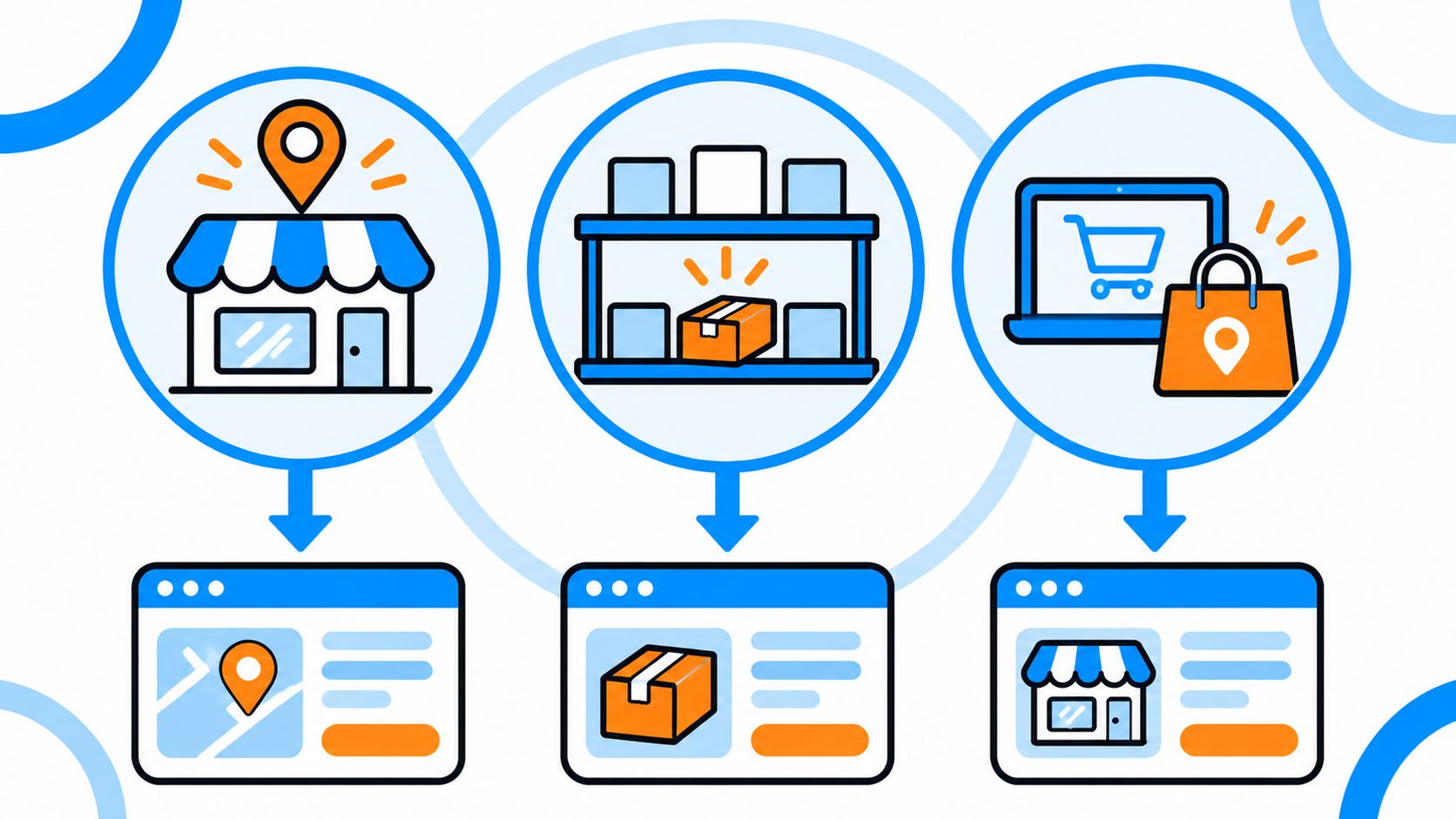
The relationship between premises, stock and ordering should be clear throughout the website.
Build around decisions customers need to make
Start with a strong Selby location page. Include the verified public address, contact details, opening hours, entrance information, accessibility and practical parking guidance. Describe parking with clear accuracy, distinguishing nearby public parking from spaces controlled by the business.
Product and category pages should explain the actual range, useful price bands where appropriate, and whether customers can buy online, reserve stock or telephone to confirm availability. An item described as available for immediate collection has to be collectable, so staff need the stock and the process to fulfil that promise on the day.
Collection information needs operational detail. Explain when an order becomes ready, how confirmation arrives, what customers should bring and whom to contact if plans change.
The ecommerce SEO checklist for Stockport retailers offers a complementary approach to product-page organisation. For a Selby shop, the immediate priority is ensuring that each commercially important page answers a distinct buying question.
Use descriptive internal links such as bridal accessories or collection instructions. A generic "click here" button gives Google and customers little to work with. Connect the location page to relevant ranges, and link product pages back to visit or collection information where it helps the purchase.
Make the pages technically usable
Add LocalBusiness or RetailStore structured data, meaning machine-readable information that describes the business shown on the page. Keep it aligned with visible details; structured data doesn't guarantee rankings.
Compress photographs before upload, retain enough detail to judge the product, and write alt text that describes the item or feature. A useful product description names what the image shows; alt text stuffed with Selby keywords describes nothing.
Check important pages on a phone using a mobile connection. Test navigation, stock information, collection instructions and the route to contact or checkout, then review Core Web Vitals, the measures used to assess aspects of loading, responsiveness and visual stability.
None of this is box-ticking. Visibility earned in the search results and then wasted on a slow or confusing page never reaches the till.
Connect reviews with customer questions
Ask for a review after a genuine purchase using a direct Google review link. Invitations should be neutral and available regardless of whether the customer appears delighted or disappointed.
Keyword scripts, incentives and pre-screening all undermine the trust reviews exist to build. Customers should describe the product and service in their own words.
Reply briefly to positive feedback and address negative feedback calmly, without disclosing private order information. Recurring questions about parking, availability or collection are prompts to improve the website, and repeated praise for a particular range hints at what deserves a stronger page.
Finish with a manageable operating checklist:
- Review access: Keep a direct review link at the till or in order confirmations.
- Response routine: Assign responsibility for reading and answering feedback.
- Location page: Maintain one authoritative Selby page with useful arrival information.
- Mobile checks: Recheck Core Web Vitals and the customer journey after substantial site changes.
Unique, useful copy on that location page should replace thin village pages outright.
Measure Footfall From Search, Not Just Rankings
Rankings alone don't show whether a shop gains customers. North Yorkshire Council's performance report recorded Selby town-centre footfall rising 2.7% year on year in March 2025 but falling 0.4% in May 2025, illustrating why a retailer needs an individual baseline rather than an assumption of steady growth (council performance report).
The useful question is whether relevant online activity leads to enquiries, visits, collections and sales. No single metric proves that whole journey.
Actions to track and what each one tells you
| Action | Where to see it | What it tells you |
|---|---|---|
| Calls from the profile | Business Profile performance data | Phone demand generated from Maps |
| Direction requests | Business Profile performance data | Intent to visit the shop |
| Website clicks from the profile | Web analytics with campaign tags | Which profile links send people to the site |
| Product-page visits | Web analytics | Which ranges attract interest |
| Offer-code redemptions | Till or code log | In-store response to a specific promotion |
| Click-and-collect orders | Order system | Online-to-shop conversion |
| Till sales on promotion days | Till data by date | Whether activity lifts sales against a baseline |
Profile call reporting should be interpreted according to the action measured, not automatically treated as completed conversations. Likewise, a direction request signals interest, not a confirmed arrival.
For a broader way to separate activity from outcomes, the performance insights from TheContentMap provide a useful companion to a shop's reporting checklist. Keep the reporting focused on decisions rather than collecting every available number.
Connect the records
- Tag profile and campaign links. Campaign tags are labels added to a URL so analytics can distinguish traffic sources and promotions. Use clear, consistent names that staff can understand later.
- Attach a unique offer code to each promotion and record redemptions at the till. A manually maintained code log is acceptable if the till system can't record them reliably.
- Separate branded and non-branded queries. Searches containing the trading name usually reflect existing awareness; product-and-place searches can reveal discovery beyond that audience.
The guide to measuring SEO leads in GA4 explains the website measurement side. Offline evidence still needs its own reliable recording process.
An illustrative Sunday-opening test
Suppose a shop promotes Sunday opening through a dated profile post and a relevant website page. In this hypothetical test, staff track calls, direction requests, offer-code redemptions and Sunday till sales for four weeks, then compare them with the previous four Sundays.
The comparison isn't proof that search caused every sale. A local event, stock arrival, changed opening duration or poor weather could affect the result.
A direction request is an intention. A redeemed code is a recorded response. Neither should be presented as the same thing as additional profit.
The monthly review should fit on one page: relevant actions, sales outcomes, unusual circumstances and one decision about the next change. That decision might be to improve a collection page, repeat a profitable offer or stop promoting a range that attracts interest without sales.
Preparing Your Shop for AI and Social Discovery
Nobody can guarantee that an AI tool will mention or recommend a Selby shop, and no social post guarantees a sale. Buying an optimisation service doesn't buy a place in an AI answer.
The useful work is making the business understandable: clear product descriptions, accessible service information, genuine reviews and a website that answers real buying questions. These are worthwhile assets even when no AI referral follows.
Test discovery without funding promises
- Standardise business details. Apply the profile checklist's name, address, phone and hours consistently across the website and directory records.
- Write plain-English descriptions for the shop's ten most-searched product lines, using available query records to choose them. If those records are sparse, start with genuine customer enquiries rather than inventing demand.
- Create a focused FAQ. Answer questions staff receive about sizing, availability, collection, accessibility and delivery.
- Ask customers how they found the shop and log the answers for an eight-week trial. Allow an unknown answer rather than forcing an attribution.
- Test one additional channel at a time. Keep investment proportionate to recorded enquiries, staff workload and till evidence.
Those quantities describe a suggested working exercise, not a performance forecast. The practical AI-search guide provides context for assessing visibility without treating citations as guaranteed placements.
Let social content support the buying journey
Instagram or TikTok may be appropriate where the intended shoppers already use them. Posts should lead towards a relevant product page, collection route or business profile where the channel permits, rather than becoming the only place important information exists.
For a retailer choosing Instagram as a test, Sup Growth's guide to improve Instagram discoverability step by step offers a channel-specific reference. Any recommendations still need to fit the shop's audience and capacity to publish useful material.
Maps should remain the local-discovery foundation for this plan. AI and social activity are supplementary tests, not reasons to neglect the information customers need before travelling.
Confirm Your Next Step This Month
Start with a 30-day working plan, not a commitment to produce content indefinitely. The first month should establish accurate information, useful destinations and a baseline for judging later work.
A practical first month
- Week one: Complete the profile fields, confirm the primary category and resolve urgent identity or address errors.
- Week two: Choose two genuine search needs and build or improve the pages that answer them.
- Week three: Set up campaign tags, promotion codes and a neutral review invitation.
- Week four: Review the first available records against the baseline and choose the next change.
The sequence is straightforward: understand how Google selects local results, repair the profile and customer-facing pages, then measure what happens online and in the shop. Early records establish a starting point; they aren't a deadline for guaranteed ranking improvements.
The SEO audit checklist for Leeds small businesses can help organise the checks without turning the exercise into an unmanageable technical project.
Choose support around the actual problem
Google Ranker Pro describes itself as independent UK specialists in search and paid advertising. It isn't affiliated with or endorsed by Google, and Selby is part of its York and nearby Yorkshire target service market, not a claimed Selby office.
Its Local SEO plan focuses on discovery in a local market, while Growth SEO covers broader organic reach and Authority SEO addresses competitive markets. The appropriate scope depends on whether the retailer primarily needs local visits, wider online sales or a more competitive search strategy.
An initial audit should identify priorities across the Business Profile, Selby location page, search-to-page mapping and measurement setup. It should distinguish urgent corrections from longer-term opportunities, without promising rankings or AI citations.
Google Ranker Pro offers a free SEO audit to help Selby retailers identify gaps between search visibility, customer visits and measurable sales. Visit Google Ranker Pro and request an audit or discuss the shop's requirements, including the stock ranges, collection services and till outcomes that matter most.